

Happy Monday! ☀️
Welcome to the 92 new hungry minds who have joined us since last Monday!
If you aren't subscribed yet, join smart, curious, and hungry folks by subscribing here.

📚 Software Engineering Articles
Why is Meta destroying its engineering organization?
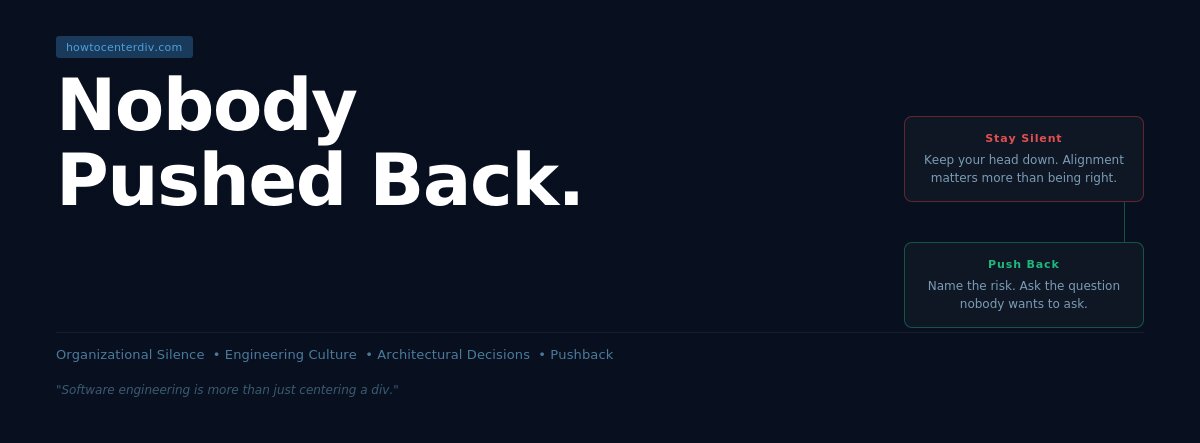
Nobody pushed back: why engineers stay silent
AWS announces AWS Blocks, open-source backend framework
Clustering billions of products for agentic commerce at scale
Life is too short for slow terminals
🗞️ Tech and AI Trends
Anthropic and Trump officials negotiate AI model access deal
Ex-Google CEO's startup debuts industrial robot with LG
Snap unveils $2,195 AR glasses, betting on post-smartphone era
👨🏻💻 Coding Tip
Rendezvous hashing enables zero-downtime cache rebalancing, rehashing only k/n keys on node churn
Time-to-digest: 5 minutes

When a buyer hits "Complete purchase," Shopify must guarantee that item is still available. Get this wrong and either two customers buy the same last unit (merchant cancels an order, loses a customer) or you tell them something is sold out when it isn't (merchant loses revenue). At Shopify's scale—$5.1M in sales per minute on Black Friday 2025—this compounds instantly across millions of transactions.
The challenge: Build an oversell protection system that handles massive concurrent reservations with ACID guarantees, all while staying inside a single database without sacrificing latency or throughput.
Implementation highlights:
One row per unit, not per item: Instead of quantity columns (high contention), create bounded pools of 1,000 rows per item/location.
SKIP LOCKEDlets MySQL skip locked rows instead of waiting on themComposite primary keys over auto-increment: Lock only the rows you filter on. Switching from secondary + clustered indexes to a composite primary key (
shop_id, inventory_item_id, inventory_group_id, id) cut lock count in half per reservationREAD COMMITTED isolation for replenishment: Avoid gap locks that block inserts. Switch from MySQL's default
REPEATABLE READtoREAD COMMITTEDwhen the pool empties and triggers inline replenishmentConsistent lock ordering across transactions: Always delete from units table first, then insert into reserved_quantities. Different lock orders create deadlock cycles—standardizing prevents them
Shadow mode dual-writes during cutover: Run both Redis and MySQL in parallel with MySQL as the shadow system. Validate correctness and performance on real production traffic before switching the source of truth
Results and learnings:
The real bottleneck wasn't queries—it was connections: CPU stayed low but transactions queued. Tagging SQL statements with business process identifiers at the app layer and tracking connection hold times at the proxy layer revealed that other checkout code was holding connections too long, starving reservations
50% fewer reads, 33% fewer transactions: Cleaning up the full checkout path and re-tuning MySQL's InnoDB thread concurrency (a "rule of thumb" setting from years ago) removed the ceiling and enabled safe scaling
Zero oversells, zero lost reservations: ACID transactions wrapping reserve and claim in the same database eliminated entire classes of bugs that existed when reservations and inventory lived in separate systems
Shopify's real lesson: the bottleneck is rarely where you're looking. They optimized locks and queries for weeks; the answer was in the plumbing—connection pooling and transaction timing in code they weren't even measuring. When numbers don't add up (low CPU but high queuing), instrument the full path, not just the hot spot.
If you're reaching for Redis, Kafka, or a custom coordination layer for high-throughput mutual exclusion, your existing database might already be enough.





ARTICLE (training goes zoom)
Faster than Light: Optimizing Generative Recommender Training Efficiency at Link...
ARTICLE (brain go brrr)
Brain-computer interface enables independent, accurate communication for man living with ALS
ARTICLE (round and round we go)
Loop engineering
ARTICLE (robots need pretty things too)
Building a design system specced for engineers and agents
ARTICLE (science got the big yikes)
U.S. science is in chaos
ARTICLE (malware party on github)
I found 10k GitHub repositories distributing Trojan malware
ARTICLE (ai learns to chill)
Teaching Sidekick to say no: automated data curation with LLM judge consensus
ARTICLE (chatgpt becomes doctor)
Improving health intelligence in ChatGPT
Want to reach 200,000+ engineers?
Let’s work together! Whether it’s your product, service, or event, we’d love to help you connect with this awesome community.

Brief: Anthropic is in active talks with Trump administration officials to resolve security concerns that triggered a ban on foreign access to its latest AI models, Fable 5 and Mythos 5, with both sides racing to find a quick resolution.
Brief: SpaceX announced a $60 billion all-stock acquisition of AI coding startup Cursor, which hit $1 billion in annualized revenue and helps developers generate and review code, bolstering SpaceX's efforts to compete with Anthropic and OpenAI in the AI race; the deal is expected to close in Q3 2026.
Brief: After laying off 8,000 workers last month, Meta CEO Mark Zuckerberg proposed a companywide AI hackathon in July to boost morale, but employees brutally rejected the idea, citing stress from covering more work with fewer colleagues and the irony of celebrating innovation while their peers get cut.
Brief: Snap CEO Evan Spiegel launched Specs, premium AR glasses priced at $2,195, positioning them as a post-smartphone computing device with see-through lenses and shared digital experiences, though the move faces skepticism from analysts citing tough consumer spending conditions and competition from Meta and Google's own AR efforts.

This week’s tip:
Rendezvous hashing (highest random weight per node) enables zero-downtime cache rebalancing on node churn, unlike consistent hashing which rehashes ~k/n keys. Use jump_consistent_hash or maglev for production.

Wen?
High-QPS caches (Redis/Memcached clusters): Node addition/removal affects only 1/n keys, not majority rebalancing; reduces eviction storms and thundering herd.
Geographic load balancing: Clients route to nearest region; node failures trigger gradual migration without global recompute.
Session stickiness without explicit tables: Route user sessions to same server via rendezvous on user_id + server_pool; survives transient server restarts.
People are weird. When we find someone with weirdness that is compatible with ours, we team up and call it love.
Dr. Seuss


That’s it for today! ☀️
Enjoyed this issue? Send it to your friends here to sign up, or share it on Twitter!
If you want to submit a section to the newsletter or tell us what you think about today’s issue, reply to this email or DM me on Twitter! 🐦
Thanks for spending part of your Monday morning with Hungry Minds.
See you in a week — Alex.
Icons by Icons8.
*I may earn a commission if you get a subscription through the links marked with “aff.” (at no extra cost to you).