

Happy Monday! ☀️
Welcome to the 351 new hungry minds who have joined us since last Monday!
If you aren't subscribed yet, join smart, curious, and hungry folks by subscribing here.

📚 Software Engineering Articles
Discord adds distributed tracing to Elixir without performance hit
Apple's synthetic task generation scales AI agent training efficiently
Harness design unlocks long-running application development secrets
PostgreSQL indexes explained: optimize queries like a pro
Dependency injection in Node.js and TypeScript done right
🗞️ Tech and AI Trends
Google's TurboQuant slashes LLM memory by 6x
MIT engineers design proteins by motion, not just structure
Apple Business platform launches for all company sizes
👨🏻💻 Coding Tip
Consistent hashing with virtual nodes rebalances distributed caches seamlessly when infrastructure changes
Time-to-digest: 5 minutes

Netflix built the Live Origin—a custom origin server that sits between their encoding pipelines and Open Connect CDN—to handle the brutal constraints of real-time video delivery. Unlike on-demand content, live streams have a 2-second window to encode, package, and deliver segments to millions of concurrent viewers worldwide.
The challenge: Build a system that can deliver video segments in milliseconds while handling defective content, traffic storms, and 65 million concurrent streams without breaking a sweat.
Implementation highlights:
Dual redundant pipelines across regions: Run two independent encoding pipelines simultaneously with different cloud regions, encoders, and video sources so when one produces a bad segment, the other typically doesn't
Intelligent segment validation: Use lightweight media inspection metadata to detect defects (missing frames, timing issues, short segments) and automatically serve the best available version to viewers
Predictable manifest templates with fixed segment duration: Use 2-second fixed-duration segments with templated URLs instead of constantly updating manifests, allowing the Origin to predict exactly when segments arrive
Millisecond-grain HTTP caching and request holding: Cache 404s with expiration policies and hold requests open for segments about to publish, eliminating redundant network roundtrips at the live edge
Separated storage paths with write-through caching: Isolate publishing writes from CDN reads using Apache Cassandra + EVCache, achieving 25ms median latency and handling 200+ gigabits per second read throughput
Results and learnings:
Blazing fast delivery: Reduced median latency from 113ms to 25ms while meeting strict 2-second retry budgets
Handles massive scale: Successfully delivered 65 million concurrent streams during the Tyson vs. Paul fight without degradation
Traffic storm resilient: In-memory metadata caching achieves 90%+ cache hit ratios during 404 storms, protecting the datastore from cascading failures
Netflix's approach proves that building for live doesn't mean sacrificing reliability. Their obsessive focus on redundancy, intelligent selection, and traffic isolation creates a system that's both performant and forgiving—critical when millions of people are watching simultaneously.



ARTICLE (oops handler supreme)
5 Useful DIY Python Functions for Error Handling
ESSENTIAL (startup vibes from the wise one)
A Student's Guide to Startups
ARTICLE (database speed demon)
Introduction to PostgreSQL indexes
ARTICLE (mobile app go brrrr)
From skeptic to convert: how Fieldy adopted Expo for their AI wearable
ARTICLE (robot whisperer skills)
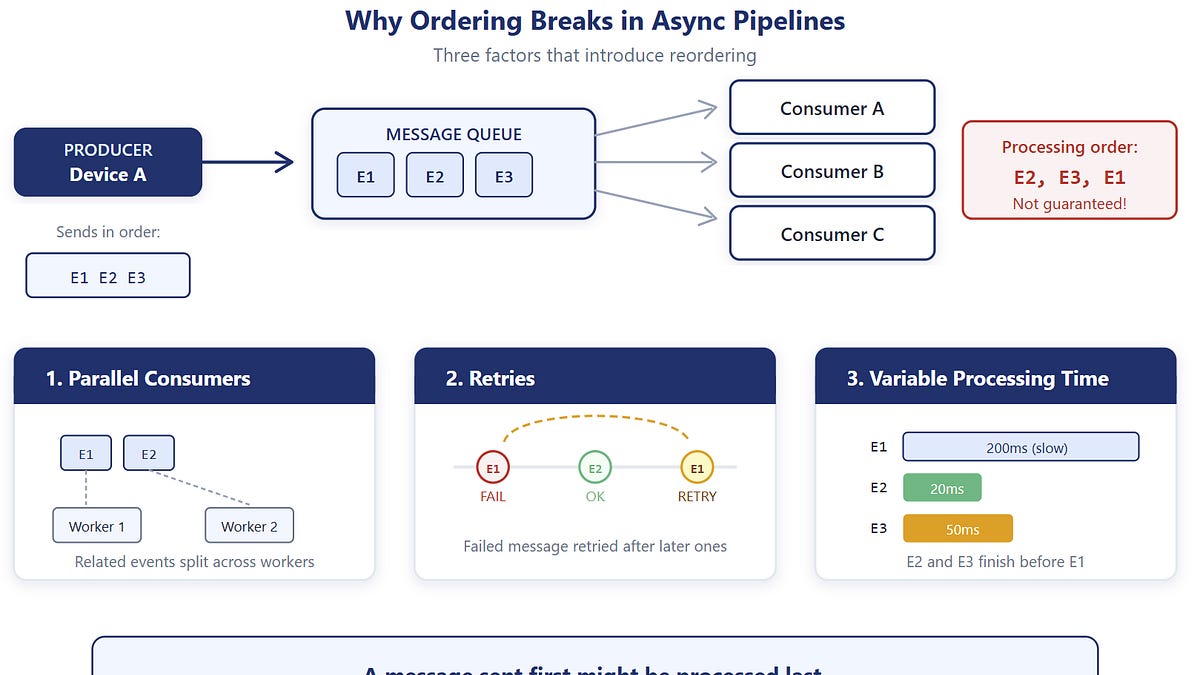
The Skill of Using AI Agents Well
ARTICLE (code ninja secrets)
What Really Makes a Succesful Software Engineer
ARTICLE (platform brain go zoom)
AI Hot Takes From A Platform Engineer / SRE
ARTICLE (train tracks teach code)
What Construction at a Train Station Taught Me About Software Engineering
ARTICLE (inject the good stuff)
Dependency Injection in Node.js & TypeScript. The Part Nobody Teaches You
Want to reach 200,000+ engineers?
Let’s work together! Whether it’s your product, service, or event, we’d love to help you connect with this awesome community.

Brief: At Nvidia's GTC 2026 conference, CEO Jensen Huang deployed strategic messaging and vision-setting to shape industry beliefs around AI factories, autonomous agents, and token consumption, positioning Nvidia as essential infrastructure while convincing supply chain partners and enterprises that persistent AI agents will become mandatory—ultimately driving GPU demand without directly selling chips.
Brief: MIT researchers developed VibeGen, an AI model that designs proteins based on how they vibrate and move rather than just their structure, enabling creation of dynamic biomaterials and adaptive therapeutics with applications ranging from more effective drugs to self-healing structural materials.
Brief: As agentic AI coding tools grow more powerful, they may push developers to work at the edges of their competence, make cognitive debt harder to mitigate at scale, and create less intelligible codebases that require deeper expertise to maintain—risks that could outweigh productivity gains.
Brief: Apple introduces Apple Business, a free all-in-one platform launching April 14 that consolidates device management, business email with custom domains, collaboration tools, and a new local advertising option on Apple Maps to help businesses of any size manage operations, reach customers, and grow securely.
Brief: Mariano Salcedo, a master's student in MIT's new Music Technology and Computation Graduate Program, is developing AI that transforms sound into dynamic visual performances using neural cellular automata, allowing users to create music-driven visuals that respond to audio in real time through an intuitive web interface.
Brief: Google unveiled TurboQuant, a compression algorithm that reduces large language model memory usage by 6x and boosts speed 8x using two-step polar coordinate conversion and error correction, maintaining output quality while making AI cheaper to run and potentially improving on-device mobile AI without cloud dependency.

This week’s tip:
Implement consistent hashing with virtual nodes to rebalance cache/shard membership smoothly when nodes join/leave, minimizing data movement. Use rendezvous (highest-random-weight) variant for simpler reproduction and no fake node overhead.

Wen?
Scaling distributed cache (Redis/Memcached): Add nodes without shuffling majority of keys; old hashes map to new ring positions in O(1).
Load balancing microservices: Route requests by content hash to same backend; graceful failover redistributes only affected keys.
Partitioned streaming (Kafka-like): Consistent hash ensures producer idempotence—same partition key always routes to same broker.
Strategy is a commodity, execution is an art.
Peter Drucker


That’s it for today! ☀️
Enjoyed this issue? Send it to your friends here to sign up, or share it on Twitter!
If you want to submit a section to the newsletter or tell us what you think about today’s issue, reply to this email or DM me on Twitter! 🐦
Thanks for spending part of your Monday morning with Hungry Minds.
See you in a week — Alex.
Icons by Icons8.
*I may earn a commission if you get a subscription through the links marked with “aff.” (at no extra cost to you).